Wednesday, August 13, 2008

Dakhme, Tower of Silence

Maybe you have heard about Dakhme, Tower of Silence. Howerev, Dakhme is an important part of Zoroastrian burial ceremony to put the corpse in. They believe we never pollute the four main elemens of Water, Fire, Air and Earth. and burying the deceased body will pollute the Erath; therefore they put the dead in Dakhme to be eaten by birds and remains its skelton, then the family gather the dried bones in a box named Estodun or OstokhanDan (Ostokhan means Bone in Persian) and keep it as far as possible.
 Zoroastrians visit the Dakhme-Yazd


anything related to death is dreadful but for my either of Dakhme or Historical cemeteries are inspiring source for knowing about the way people and civilizations by which lived. Evenmore, they have no more such grandeur and mystic identity, maybe somewhere to hang around!


the famous Dakhme of Yazd in sunset, really missed it!

Wednesday, June 25, 2008

The first three women

Under Reza Shah's (founder of Pahlavi Dynasty) reforms, Iranian women had found their way to express themselves in various ways as men. The first three women who attended university in Iran are shown below.
Do you "University of Tehran" is the the first modern university in Iran which has been inaugurated in 1934?

Thursday, June 12, 2008

Iran's Flag colors

watch Iran's Flag 3colors of Green, White and Red in this ancient Shusa Glazed Tile on Fravahar  symbol.


Sunday, April 20, 2008

BaadGir (wind tower)

Downward south of Iran from Tehran the Kavir climate affect people life, e.g. their architecture which is adopted to the condition. BaadGir or wind tower is one of the particular innovations of Kavir architects who derived it to escape the unbearable Kavir heat. Most of the times, a BaadGir is constructed above an Ab-Anbar which is a big cellar water store to get a double result; cooling the drinking water which is rare in Kavir and refreshing the desert wind by water before entering the rooms in hot summer days.
Dolat-Abad Garden has one of the most famous BaadGirs in Yazd that is said as the tallest. Ab-Anbar shesh BaadGiri (or Ab-Anbar with 6 BaadGir) is another survived touristic site in Yazd.


Pic1: My Australian Friend, Andrew with his friends in DolatAbad Garden, Yazd

Pic2: Laft port in Qeshm with a dozen of white BaadGir

Sunday, March 23, 2008

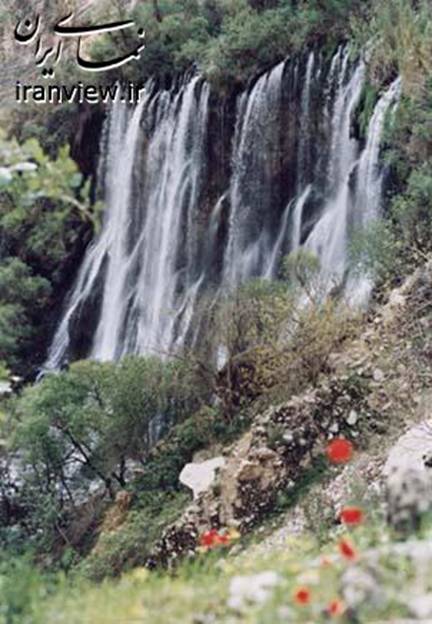
The Longest Fall of the Middle East

Abshar-e Shuy (Shuy the fall), the longest fall in Middle East is located in Dezful, Khuzestan, Iran. Its length is over 80 meters and has 50 meters width. As mountainous path is inaccessible, the current way to Shuy the fall is 10km way start from TeleZang Rail Station.

* translated from iranview

Sunday, March 02, 2008

Fravahar

In Zoroastrians beliefs, human kind is composed of five Powers: Body, Conscious, perception, Spirit & Fravahar. Fravahar (Fravashi) the most valuable one is consist of "Fra" as foreword & "Vahar" as driving which is the preexisting external higher soul or essence of a person associated with Ahura Mazda and will be backed to Ahura Mazda after death. It prevents the one's spirit from propensity to lie and incompetence and gives him the power of innovation to pursue the theism in order to become a Spenta man.
Under Achaemenids, an ancient illustration was developed as the national Symbol with the basic thoughts of Ashu Zarathustra.
Pic1: illustration of Fravahar.

Each of 7 parts of this symbol resembles a concept:
- The old man face reminds one to use the wisdom and experience of elderly.
- His upward hands are praying Ahura Mazda which symbolizes development and growth.
- The ring in his hand is the symbol of Mithra and reminds the one to follow the Asha path.
- His wing has 3parts of good thoughts, good words and good deeds or Humat, Huvakht and Hurasht in Pahlavi.
- The middle ring is the eternal world and circulation of life which means everything, good or bad, backs to itself.
- Two hanging strings resemble following Spenta Mainyu (the right side) and refusing the Angra Mainyu (the left side).
- the 3parts wing below the middle ring is discarding the bad thoughts, bad words and bad deeds or Dojmat, Dojvakht and Dojorasht in Pahlavi.

Pic2: the ancient illustration of Fravahar in Assyrian, Meddian and Elamite has been traced.

The unity of Fravahar which is a beam from Ahura Mazda in all creatures is the most interesting issue related to this concept. The Spirit may pollute but Fravahar never does and after death backs to Ahura Mazda.
Maybe heard about Iranian’s New Year habits of Haft Sin, Khane Tekani (House Cleaning), Charshanbe Suri and so and so. Each of which has a pretty origin, e.g. House Cleaning: Zoroastrians clean their houses in the last five days of the year since they believe Farvardin (First Month of Solar Calendar) in devoted to dead’s Fravahar who back to their families in this month, then a cleaning the house is a respectful hospitable gesture to ancestors.

Sunday, February 24, 2008

Are you inspired for traveling throughout Iran?

I've a website which consist of summary information about Iran and traveling to Iran with the below categorization:

1. Why Iran?
     a. Iran By the others
     b. Iran By the author
          I. History
          II. Language
          III. Literature
          IV. Religion
          V. Culture & Custom
          VI. Art
               Music, Dance & Theatre
               Painting (miniature) & Calligraphy
               Architecture
               Handicrafts [Carpet & Kilim - Sofal (Pottery) & Ceramic - 
               Kashi (Decorative Tiles) - Khaatam Kari (Inlaid works) - 
              Qalam Zani (Engraving) - Qalamkar (Calico)]
          VII. Cuisine
          VIII. Nature
               Climate & Landscape
               Attractions (Kavir or Desert - Mountain - Cave - 
              Jungle - lake - Lagoon – Beach)
          IX. Cities
               - Northern Provinces or the Caspian Coast 
               (Gilan, Mazandaran, Golestan)
               - Eastern Provinces (Sistan, Khorasan)
               Southern Provinces (Kerman, Hormozgan, 
               Fars, Boushehr, Khuzestan)
               - Western Provinces (Lorestan, ilam, Kermanshah, 
               Hamedan, Kordestan, Zanjan, Azerbaijan-Qarbi, 
               Azerbaijan-Sharqi, Ardebil)
               - Central Provinces (Qazvin, Tehran, Semnan, Isfahan, 
               Yazd, Kohkiluye, Charmahal, Qom, Markazi)

2. Plans for your discovery (Itinerary)
     a. Activities in Iran
          Sight Seeing in cities & villages
          Nomad Visiting
          Mountaineering
          Hiking in nature (plain, Jungle, Kavir, Cave)
          Cycling
          Camel Riding, riding on horses
          Bird Watching
          Butterfly Watching
          Aviation Sports (paraglider)
          Snow Sports (Ski resorts)
     b. Proposed tours
          Cultural Tours
          Ecotourism
          Remedial Tours (Bee - Leech - Massage - 
          Mineral Waters - Sun – plains)
          Silk Road Tours
          Middle East Tours
          Central Asia Tours
     c. Tailor made Tours

3. Get Set
     a. Fiscal plan (Costs)
     b. Visa Process
          I. Booking your flight
          II. Applying for visa
          III. Customs & Duty
     c. Packing your luggage
          I. Necessities
          II. Clothes
               - Women
               - Men
     d. Welcome to Iran
          I. Get around
               - Among Cities
               - In Cities
          II. Exchanging Money
          III. Accommodation 

of course! it's under construction.